Guide
Bosch vs Sub-Zero Refrigerator: Which Fits Your Kitchen?
A fair Bosch vs Sub-Zero refrigerator comparison: construction, cooling design, wear patterns, repair ranges and parts, so you can pick the right one.
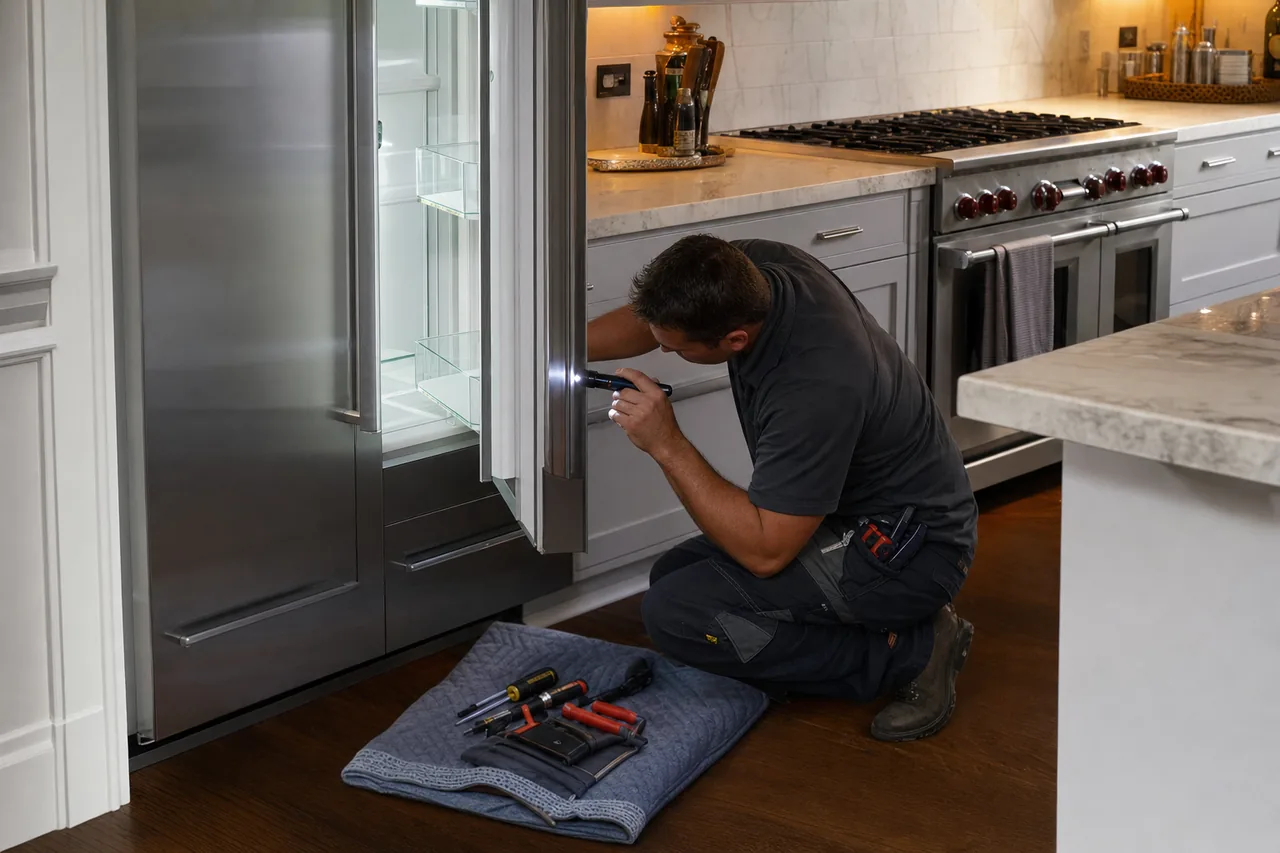
Sub-Zero and Bosch both make well-built refrigerators, but they solve different problems: Sub-Zero builds full-size built-ins with two separate sealed systems, while most Bosch refrigerators are counter-depth French-door units cooled by one compressor. If you want a refrigerator you keep in the cabinetry and repair in place for 20 years or more, Sub-Zero is the stronger fit; if you want a well-made counter-depth unit at a lower purchase price and accept the 10-to-15-year service life typical of most refrigerators, Bosch is the sensible choice.
Neither is a bad buy. The right answer depends on your cabinet opening, how long you plan to stay, and whether you would rather repair or replace when something big fails.
How are Sub-Zero and Bosch refrigerators built differently?
Sub-Zero makes refrigeration only. Its classic built-ins stand about 84 inches tall in widths from 30 to 48 inches and sit flush with the cabinets or wear custom panels. Its integrated columns run from 18 to 36 inches wide, so fresh-food, freezer and wine columns can be lined up side by side. These are heavy, steel-framed cabinets meant to stay put for the life of the kitchen.
Bosch is part of BSH, the group that also owns Thermador and Gaggenau. Most Bosch refrigerators in homes are counter-depth French-door models that slide into a standard 36-inch opening and sit close to the counter line. Bosch also sells panel-ready built-in columns in its Benchmark line, but most owners are really comparing a Sub-Zero built-in with a Bosch counter-depth unit, and that is the comparison here.
How does the cooling design compare?
Most full-size Sub-Zero refrigerators use dual refrigeration: two separate sealed systems, each with its own compressor and evaporator, one for fresh food and one for the freezer. The compartments never share air, so produce stays humid, the freezer stays dry, and freezer odors stay out of the fresh-food side.
Many Bosch counter-depth models cool both compartments from a single compressor, with airflow controls dividing the cold. Some add separate evaporators or extra humidity controls, so check the spec sheet of the exact model. A single-system layout is simpler and less expensive to build, and it works well; the trade-off is that when that compressor or sealed system fails, both compartments warm at once.
Heat leaves the cabinet in different places, too. Classic Sub-Zero built-ins put the compressor and condenser at the top, behind the grille above the doors, so a technician works from the front without pulling the unit out. Bosch counter-depth units usually keep them at the bottom and back, so some repairs mean rolling the refrigerator out. Either way, a healthy unit holds about 37°F in the fresh-food section and 0°F in the freezer.
Which brand holds up better over time?
Both brands rely on the same basic parts as any refrigerator: compressors, fans, defrost heaters, door gaskets, ice makers and control boards. The real difference is how each design is meant to be kept. A Sub-Zero built-in is designed to be repaired rather than replaced, because the panels and opening are custom. A Bosch counter-depth unit is easier to swap, since a same-width replacement fits the same opening.
| What to watch | Sub-Zero built-in | Bosch counter-depth |
|---|---|---|
| Condenser location | Top, behind the grille; collects kitchen dust and grease | Bottom, behind the kick plate; collects dust and pet hair |
| Cooling layout | Two sealed systems | Usually one compressor |
| If a compressor fails | Only that compartment warms | Both compartments warm |
| Door seals | Long gaskets on tall doors | Gaskets plus the French-door center flap |
| Usual path after a big failure | Repair in place | Repair or same-width swap |
On either brand, cleaning the condenser a couple of times a year and keeping the door seals clean does more for long life than anything on the spec sheet.
What do repairs and parts cost for each brand?
Our typical ranges are the same for both brands, because a failed fan or a worn gasket is the same kind of job on either one. The firm quote is given on site after diagnosis, and the diagnostic visit is credited toward the repair.
| Repair | Typical range |
|---|---|
| Diagnostic / service call | $95–$149 |
| Common refrigerator faults | $300–$750 |
| Door gasket / seal replacement | $150–$450 |
| Ice maker repair | $250–$650 |
| Sealed-system / compressor repair | $800–$2,200 |
Sub-Zero parts come through the brand’s own distribution and Bosch parts through BSH; lead times vary by model and age, so ask about availability before approving a sealed-system job on an older unit.
The repair-or-replace math is where the brands split. A sealed-system repair in the $800–$2,200 range usually makes sense on a Sub-Zero built-in, because the alternative is a new built-in and often new panels. On a Bosch counter-depth unit past the middle of its life, the same repair deserves a harder look. Our refrigerator repair page explains what a visit covers, and repair pricing lists every typical range.
Which one fits a Great Neck kitchen?
Many Great Neck houses were built in the first half of the 1900s, and their kitchens have usually been redone since, often around an existing cabinet opening. That opening often settles the question: a 36-inch space framed for a counter-depth unit will not take a 42- or 48-inch Sub-Zero without new cabinetry, and an opening framed for an 84-inch built-in leaves a gap above a shorter model. Measure width, height and depth before you shop.
- Choose Sub-Zero if you have a built-in or panel-ready kitchen, want separate cooling for fresh and frozen food, and plan to keep the refrigerator for the long haul. See our Sub-Zero page.
- Choose Bosch if you have a standard 36-inch opening, want counter-depth styling at a lower purchase price, and are comfortable replacing the unit someday. See our Bosch page.
North Shore Built-In Repair is an independent service, not manufacturer-authorized, and we repair both brands in Great Neck, Kings Point, Manhasset and Port Washington. Call (475) 264-6460 if either one stops holding temperature.
Frequently asked questions
Is a Sub-Zero refrigerator worth the extra cost over a Bosch?
It is worth it if you want a built-in that stays in your cabinetry and gets repaired in place for 20 years or more. If you have a standard 36-inch opening and expect to replace the unit someday, a Bosch counter-depth model gives you good performance for less.
Does Bosch make a built-in refrigerator like Sub-Zero?
Yes, Bosch sells panel-ready built-in columns in its Benchmark line. Most Bosch refrigerators in homes, though, are counter-depth French-door units rather than full built-ins.
Which brand is cheaper to repair?
The same fault costs about the same on either brand, and our typical ranges apply to both. The bigger difference is whether a large job, such as a sealed-system repair, beats replacement; the firm quote is given on site after diagnosis.
What temperatures should either refrigerator hold?
Set the fresh-food section to about 37°F and the freezer to 0°F. If either section drifts several degrees for a day, have the condenser, fans and door seals checked.